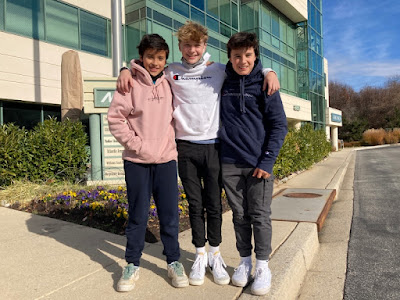
I just dropped off my 13-year-old at his first BBYO overnight (and second BBYO event), so it felt like a right time to look back at my own adventures in this beloved, international Jewish youth group.
From 1987 to 1990, I was a proud member of the Connecticut Valley Region (CVR) of what was then officially called the B’nai B’rith Youth Organization. BBYO runs a mix of programming: social, community service, education, Judaic, and athletic. (I wasn’t much use for that last category.)
I also wasn’t a natural joiner. For the first half of our first year of high school, Mike, a guy I’d known since second grade and with whom I’d gone through Hebrew school, hounded me about it, insisting I’d love it. Eventually I caved, thinking I’d prove him wrong. But soon I would be elected to a chapter board position for my sophomore year, and regional board positions for junior and senior year.
I would become one of the most enthusiastic BBYO members in my region.
I owe Mike—and BBYO—a lot. I’m coming up on 50 and still regularly reflect on how in my teenage years, this experience was the most significant factor in my development.
Here are 20 of my most formative BBYO moments (in approximate chronological order). For each, I indicate what I learned; in some cases, it’s more accurate to say what was reinforced. The friends who feature most in these memories are the aforementioned Mike as well as Seth, Darren, Kevin, and two Matts (B. and S.).
Midnight Madness
This was a scavenger hunt spread across multiple towns in the New Haven, CT, area, so each team of four needed a car.
It took place at night. It was February of my freshman year. It was cold. I had no gloves or hat. I did not yet have my driver’s license (I was 14) nor did I have any money on me. Of course no one had cell phones.
All of this made it even more distressing when the older boys on our team accidentally stranded Darren and me at a McDonald’s in a rough neighborhood. (They thought we’d left with another team; we were simply in the bathroom.)
After three nerve-racking hours, by chance, another team stopped by that restaurant and rescued us.
Oh, this was my first BBYO event.
I did not tell my parents till much later how wrong it went. Yet also right, or else I wouldn’t have returned for the next event. It’s the only entry on this list for which I have no photos.
WHAT I LEARNED: how to stay calm and be resourceful in a stressful situation.
The Ruach Rap-Up
My region, CVR, had about 14 chapters. Most were either all-male (AZA) or all-female (BBG). My chapter, Ruach, was one of only a couple that were coed. “Ruach” means “spirit” in Hebrew.
Each chapter would produce a newspaper for distribution at the marquee BBYO event, the regional convention (held twice a year, in a hotel, for two nights). These papers would include recaps of events, short essays, humor pieces, and other often ribald attempts to entertain the membership. Ours was called The Ruach Rap.
I was elected editor and decided to add a monthly one-page newsletter that would be mailed to each chapter member’s home—meaning it had to be less inappropriate than the newspapers because parents could have seen it first. I called it The Ruach Rap-Up.
me with Matt S., who succeeded me as editor
WHAT I LEARNED: how to build a new template, how to set and keep deadlines, how to delegate, how to edit.
helping the young, the sick, those experiencing homelessness
Self-explanatory!
visiting a hospital on Christmas Eve;
I have no idea what I am dressed as
but it sure is festive
donations we collected for people experiencing homelessness
WHAT I LEARNED: the imperative to give time to those less fortunate (or less old).
video to welcome new members
When I was still a new member myself, Mike, Seth, Darren, Matt B., and I created a well-intentioned but at times misguided video to introduce BBYO to (other) new members. I don’t remember if we ever actually played it for any new members…but it was a blast to make.
Here is the heart-pounding opening:
WHAT I LEARNED: how to collaborate/compromise, a wee bit about film production.
“Bad” parody
At my second convention (fall of my sophomore year), I was pushed outside of my comfort zone for three minutes…and it changed the course of my life. The one pushing? Mike, the same kid who pushed me to join BBYO. (He was nothing if not consistent.)
Years before the child molestation accusations against Michael Jackson, and months before “Weird Al” Yankovic released his “Bad” parody song “Fat,” I wrote a “Bad” parody called…“Bad.”
In October 1987, I shared it with Mike and other friends at a chapter meeting. The next month, at fall convention, Mike urged me to sign up to sing it during the Saturday night talent show. As I did when he pushed me to try BBYO, I resisted at first. Then he said he and our other good friends would support me as “backup dancers.” (Never mind that most of them couldn’t dance.)
So I signed. And I sang. But I was so nervous that I sat the whole time. To my surprise (and relief), the audience loved it.
I ended up singing it publicly maybe a dozen more times over the next three years—at Sweet 16 parties (by request, for the video), at other conventions, even at my high school senior picnic. (Keep in mind my classmates had no idea that my geeky friends and I were cool every weekend in BBYO nor would they have pegged me as the kind of kid who would perform solo in front of a crowd.)
Though I did not sing in public beyond high school, a huge (and fulfilling) part of my job is public speaking, and I might never have gone that route if not for “Bad.”
WHAT I LEARNED: how to overcome fear, how to perform live, how to trust a friend in taking a risk.
Beau-Sweetheart
The winter of my sophomore year, the region held its first annual Beau-Sweetheart Dance. We voted on a regional Beau and Sweetheart. Somehow I got on the ballot as the nominee from my chapter…and even more somehow, I won. I believe the criteria was “niceness” and maybe a little bit “cuteness.”
I’m still friends with Leigh, the Sweetheart.
WHAT I LEARNED: how to congratulate people you win against.
The Late Valentine Match-Up
Seth and I created a low-tech matchmaking questionnaire and solicited our region to fill it out. We revealed the matches at spring convention (which took place after Valentine’s Day, hence the name of the endeavor).
We presented the results on a big banner:
It wasn’t meant to be a dating app (and not just because apps hadn’t been invented yet). It was just a fun, fairly low-maintenance activity that could lead to a new friendship. We did it twice more, then passed the torch before graduating.
WHAT I LEARNED: the importance of trying to see situations from the perspective of other people so you can be as sensitive as possible to their feelings.
regional board
At spring convention of my sophomore year (the same at which the Late Valentine Match-Up debuted), Seth, Mike, and I ran for one of six main AZA regional board positions and won.
delivering a campaign speech
(in an AZA fraternity-style sweater)
In the span of a year, with respect to BBYO, I went from “hard pass” to “fast track.”
My position was Convention Coordinator, the only one with a non-Hebrew name. (Seth was S’gan, or Programming Vice President; Mike was Moreh, or Membership Vice President.) I proposed that my position be renamed Rakkaz, which is Hebrew for “coordinator.” (We spelled it with two Ks but now, thanks to Google, I have learned that it should be only one.)
The following spring, Seth won Godol (President) and Mike was reelected Moreh. I ran for S’gan…and lost.
regional board my junior year
regional board my senior year
WHAT I LEARNED: how to sell yourself, how to live up to responsibility, how to lose gracefully.
“The Twilight Zone” convention
Convention Coordinators—sorry, Rakkazes—chose the theme for the convention they planned, and my co (BBG partner) Joy and I went with “The Twilight Zone.” (I was a huge fan of the show.)
At age 16, I co-organized an entire weekend of programming for 265 kids.
me sporting the convention T-shirt,
which I designed, and two friends
Highlights:
- icebreaker combining jigsaw puzzles with the then-popular ethical conundrums board game Scruples
- “Hands Across Convention,” inspired by the 1986 fundraising stunt Hands Across America
- a screening of/discussion about a Holocaust-themed Twilight Zone episode, “Deaths-Head Revisited”
- the first-ever professional group photograph of convention attendees
- a “guess the baby photo” contest
material for convention programs
WHAT I LEARNED: how to juggle many balls at once, how to work with adults (booking speakers, etc.), how to host a huge party.
winning a character award
The spring of my junior year, I was surprised to win a regional award named for a former AZAer named Bruce Newman. Though I was immensely honored at the time, in prepping this post I could not remember who Bruce was (other than that he was before my time) or what exactly the award was for. I knew it was related to character.
Unfortunately, I no longer have my award and have only a couple of photos that captured it, none close-up. Here is one:
The award is hanging at top left; sorry about the sweater.
The current CVR regional director told me that the award is still given out. Its purpose: to “memorialize the warmth, kindness and devotion that Bruce brought to CVR AZA and to recognize other young men whose love for the order and efforts on its behalf will keep the order strong and sustain it an eternity.” But he found no details about Bruce himself.
WHAT I LEARNED: Kindness is its own reward, and sometimes this one, too.
Noar LeNoar
In this summer program, a delegation of about 15 BBYO members from other countries (including Israel, France, Spain, and the United Kingdom) tour several BBYO regions in America and individually stay for a few days with volunteer host families at each stop. I don’t remember any organized programming; it was essentially a cultural exchange and free-form social experiment.
The summer after my sophomore year, my family didn’t host someone; the next summer, we were graced with the polite presence of a British boy named Jonny. I let him try driving our car—his first experience driving on the right side of the road (the opposite of England). I don’t even think he had his license yet! (We were on a small dead-end street. We survived.)
WHAT I LEARNED: International differences plus Jewish similarities makes for a fascinating friendship. Plus non-American girls are also cute.
worlds collide: BBYO and school
For my junior prom, I asked a girl I knew from BBYO. (She also asked me to one of her school dances.) For a formal BBYO dance during my senior year, I asked a girl I knew from school.
senior BBYO dance
I was not the only one of my friends to bring a BBYO
girl to junior prom; Mike, Seth, Darren, and Kevin did, too.
WHAT I LEARNED: the pleasure of introducing friends to new people and experiences.
Mazkir Pin-Up Page
Though I lost the race for S’gan, I immediately threw myself into the ring for another position...and won. So senior year, my regional board position was Mazkir—Secretary and Co-Editor of the regional newspaper, The CVR Connection.
Each AZA chapter board also had a Mazkir, and I rallied them into a posse of sorts—something that wasn’t usually done. At events, we made some good-natured noise mostly for our own entertainment, and on occasion challenged groups of other board members to volleyball.
But the most prominent thing that came out of this silly side venture was the “Mazkir Pin-Up Page”—something we made, copied, and handed out…and something that no one asked for.
of course Batman makes an appearance
WHAT I LEARNED: nothing. It was just funny.
Biblical fact of the issue
Once, there was no internet. In those days, researching even basic information was more involved. As editor of the regional newspaper, I wanted to incorporate something both Jewish and historical/educational, so each issue, I shared a short fact about the Old Testament and the Bible in general. I wish I remembered the sources I used to compile those facts.
It was the kind of thing that most kids wouldn’t think much about, and some probably didn’t even bother to read it, but I was proud of it. In its own small way, it was a service, Jew to Jew.
WHAT I LEARNED: facts about the Bible.
International Convention
In my BBYO era, International Convention (IC) was a weeklong summer event for several hundred BBYOers, held at a camp in a Pennsylvania town with the idyllic name Starlight. (Now it’s held at a city hotel during the school year, and I’m told thousands attend.) I went to two ICs, the second being more seminal for me, for two reasons.
One: our region’s delegation of 20 boys was, at the time, the largest to ever attend IC. For our talent show entry, this group let me choreograph a performance piece of Paul Simon’s “You Can Call Me Al.”
It was more than a lip sync. Because there were a lot of us, there was always more than one thing going on during the skit: I was flipping pages of a giant pad to reveal drawings that interpreted the lyrics, two guys were front and center mimicking Paul Simon and Chevy Chase from the music video, for some reason two other guys showed up as Saturday Night Live bodybuilder characters Hans and Franz, one or two guys acted like a dog (accompanying the lines “dogs in the moonlight” and “get these mutts away from me”), one guy was an air flutist, and at least five guys represented a full air horns section.
Was it high art? No. Did it put smiles on faces? Yes.
Two: one night, our big delegation got a little too spirited at one point and the adult staff gave us a consequence for being disruptive: we had to choose between attending a popular event called Life in which the international leaders would recap their fondest BBYO memories or having a gathering of just our region for a more intimate session of soul-bearing. (Ordinarily, we’d be allowed to do both, the latter after the former.)
Surprisingly, we were not all in agreement. I chose the latter—and eight others (including Kevin and Matt S.) joined me. The other eleven chose to attend Life—and some of them criticized me for opting not to. At the time, because we’d been punished, I felt it more important to commiserate and reflect as a region than to listen to virtual strangers share stories that may not be as relevant to us.
It put friendships to the test—for the first time, I was arguing with fellow leaders, and tears were shed. Because of that, it was a major growth moment for me. The next day, on the bus home, we all talked about what happened and made peace with each other.
Not as seminal, but a fun crystal ball glimpse of my future: at some meeting, I passed around an idea for a program theme (which we called a “thrust”): Project B.A.T.M.A.N.—“Bringing Attention To Mass Anti-Semitism Now.” (This was 1989, the year of the first Tim Burton Batman film.) I was asking for input from fellow BBYOers from around the world.
again with the Batman
While I remain impressed that I was able to retrofit a relevant acronym to an existing superhero name, you can see that the first region to respond not only made a great point but also came up with an alternate acronym for another superhero!
Also, for some reason, the boys would carry briefcases to events (not just IC). Perhaps odd, but they did come in handy. How better could we transport our hacky sacks and dart guns?
WHAT I LEARNED: how to stage-manage a big group at once, how to disagree constructively, how to move past uncomfortable situations.
notable figures in history
A lot of foundation-building happened at my last convention, spring of my senior year. I was part of a group that put on what you might call a thought piece consisting of inspirational words from well-known people: Martin Luther King Jr., Franklin Delano Roosevelt, Neil Armstrong, Stephen Biko, and surely others I can’t recall. (Hopefully some women!) I portrayed FDR, Biko, and one of the astronauts. (All stretches, but it wasn’t about the acting.)
This program also included scripted bits from important human rights movements; Matt S. and I were in one about gay rights—quite progressive for teenagers in 1990!
WHAT I LEARNED: how to distill key elements of big moments, the importance of doing what you can to support marginalized communities.
Ruach’s Greatest Skits
At every convention since fall of our sophomore year (so five times), my friends (now called the Ruach Six, even though we were technically seven) did a skit in the talent show—and to brag, ours were usually the best.
We spoofed Star Trek and “Weekend Update” from Saturday Night Live; we added humorous flourishes to the song “Flash” by Queen and to the theme from The Flintstones.
For our final talent show appearance, we did a greatest hits compilation called, appropriately, Ruach’s Greatest Skits. This means we redid all five previous concepts (with new material for Star Trek and SNL).
By then, younger siblings of four of us were also BBYO members, so we wrote a script for them in which they were remembering what their big brothers did in BBYO. (They were gracious to agree to do this.) This framing narrative lent some charm—and served a practical purpose, too: while our kid brothers and sisters were on stage “reminiscing,” we were backstage changing for the next skit.
Hans and Franz again, as part of “Weekend Update”
The Flintstones
Here is the Flintstones routine (by me alone, decades later):
Typically, a talent show skit would last only as long a song, but our grand finale went on for a whopping 30 minutes! Though that was a bit cocky, no one shepherd’s-crooked us offstage. We felt we’d given so much to the organization and it was generous of the audience to give us this moment; then again, it was meaningful nostalgia for many of them, too.
For a bunch of teen boys, most of whom were not theater kids and all of whom had a lot going on because it was senior year, it was quite remarkable that we were able to pull off something this ambitious (with almost no rehearsal). It is one of my dearest memories not only from BBYO but from life.
WHAT I LEARNED: If you’re delivering something enjoyable, length doesn’t matter.
“Tell Us a Tale”
In BBYO, I debuted my “public” self by sitting on stage and singing, and that’s how I ended it. Only this time, no one—not even my closest friends—knew it was going to happen. After our Greatest Skits extravaganza, I performed a song set to Billy Joel’s “Piano Man.” It was meant to be a poignant tribute to my best friends and my time in BBYO, punctuated by some self-taught, out-of-tune harmonica.
It was my first standing ovation.
WHAT I LEARNED: Whenever possible, make something good a surprise.
giving Life
As mentioned above, a worldwide BBYO tradition is the rite of passage called “giving Life.” It’s each graduating senior’s moment in the spotlight and last hurrah—the chance to speak about whatever you want in front of the assembled region. (There are time limits depending on your board positions.)
Kevin (red hat), Mike, Matt B., me (holding sheet),
Darren (red shirt), Seth (pink pants)
Usually everyone cries the whole time.
WHAT I LEARNED: Summarizing four densely scheduled and emotionally charged years in a few minutes is a worthy challenge for your mind and your heart. Also, saying goodbye even when you have a feeling you’ll see each other again can still be painful.
“Up You Men”
This is the official song/chant of AZA. Anyone at any time can start it simply by shouting “Up you men!” It sets off a Pavlovian response from all AZAers within earshot—they will rush to you, form a cluster, and jointly finish the song at the top of their lungs.
“Up You Men” is a real up-with-people experience—a bond of brothers that feels eternal.
WHAT I LEARNED: This song—and much else in BBYO—exemplifies the agency of both any one person and the group as a whole. You’re always part of something bigger—yet you always have a singular voice.
As an alum, I’ve had the privilege of speaking about my time in BBYO at several BBYO events…something I am able to do because of skills I began to hone in BBYO.
Oh, that guy Mike who hounded me for months to join BBYO? And those other guys in the Ruach Six/Seven?
They’re still my best friends today.
greeting a new morning in BBYO in a great mood
(and terrible outfit)