Thursday, November 10, 2022

Introducing “Songbook,” a Kennedy Center web series starring nonprofessional kids

I’m thrilled that I can finally announce a project I’ve been working on for more than two years—and it’s unlike anything I’ve done before.

During the lockdown of the first COVID summer—2020, not that anyone could forget—my friend and fellow author and Newbery recipient Kwame Alexander asked if I would like to brainstorm virtual programming ideas for young people that he and I could pitch a beloved cultural institution 20 minutes from where I live—the Kennedy Center for the Performing Arts in Washington DC.

Of course I did.

So I prepared ten concepts to start, and more after the initial batch. All were an attempt to blend education and entertainment, and all prominently featured nonactor kids. 

We narrowed down the ideas to three. On 2/11/21, by Zoom, Kwame, fellow author Mary Rand Hess, and I presented the selected ideas to the Kennedy Center Director of Education David Kilpatrick and Director of Music Education Jennifer Bowman—truly stellar people. The idea they chose to produce:

logo designed by Piumi Perera

It’s unlike anything the Kennedy Center has done before.

Each episode, a middle schooler who wrote a poem inspired by a book of her choice works in person with a professional musician to set that poem to music—then performs it with the musician. And a surprise guest (different each time). 

In short, it’s a musical comedy reality show for kids. 

More precisely, it’s an unscripted/scripted hybrid. The child (and special guest) are just being themselves—no formal scripted lines. The host and musician are partially scripted but have the freedom to adlib throughout. 

We’re launching soon with three episodes, each running about 10 minutes. They will stream for no charge on the Kennedy Center site, YouTube, and Facebook.

The host is the indomitable Vaughn Ryan Midder. He and I had not met before. I liked him instantly and he is a collaborator’s dream—clever, reliable, quick-witted, great with children.

The professional musician is a perpetual mensch—Randy Preston, who often works with Kwame (and who has also worked with Vaughn Ryan). Randy is the full package—talented, warm, flexible, great with children. 


In addition to writing the scripts, I was honored and challenged to take on roles that I didn’t envision at the start—director and producer. (They even gave me a director’s chair on set…but I ended up standing the whole time.)


Throughout the rest of 2021, we developed Songbook remotely (and once, in August, in person). We originally planned to shoot all three episodes over one weekend in December, then moved it to January 2022, then to June, due in large part to Omicron. 

We did a full-court press to solicit submissions from kids in early 2022, primarily in March. I asked DC-area education leaders and literacy organizations including PEN/Faulkner Foundation, An Open Book, and Turning the Page to blast out to their networks and they kindly obliged. 

I also contacted teachers directly, asking them to “hand-deliver” the opportunity to the avid writers (and musicians) among their students. Occasions like this often require an adult to encourage a child one-on-one; sending a flyer home in a backpack often results in nothing more than a crumpled and forgotten flyer at the bottom of a backpack.

The submissions we got were pure gold. 

In May, we had the immense pleasure of notifying the young poets whose work we selected and clandestinely confirmed our special guests. 

Originally we planned to film episode 1 on June 11 and eps 2 and 3 on June 12. This would give us a full-day cushion for the learning curve of the first shoot. But due to circumstances beyond our control, we ended up having to do two eps on our first day and schedule the third for another week entirely.

Those circumstances included a Pride celebration and an anti-gun rally, both of which would take place nearby. I didn’t want our talent to get stuck in traffic or to have to get up extra early to avoid the crowds.

I was a bit nervous to commit to shooting two—in particular, the first two—eps back-to-back on the same day. 

Film dates were set for June 12 and July 11. Each episode took three hours to shoot (and additional time, of course, to set up and break down, then later edit). 


Our primary filming location was Studio K in the REACH, the gorgeous standalone extension of the Kennedy Center that opened in 2019. We also shot a key scene in front of and in the Grand Foyer of the original building. We filmed the outdoor scene at different times of day, which lent each show different light.

The songs Randy and his young partners crafted for Songbook are truly fantastic—catchy and distinct. What makes this even more impressive is that the duos met for the first time on camera and had to begin converting the poems to lyrics almost immediately after—plus had less than an hour to bang it out. The only other person I’ve seen create musical magic in such a short time (though, of course, I was not in the same room) is Paul McCartney...

The special guests have a role related to the song…but not as singers. 

Estimating how long it would take to shoot each ep was essentially a shot in the dark, but I was proud that we managed to stay on schedule.

THE SHOOTS

episode 1 (shot)/episode 3 (numbered): 6/12/22 morning

young poet: Alexandra from Virginia
special guest: ?

Snafus:

Due to light rain, we could not film the opening scene in front of the Kennedy Center as planned. Luckily, Plan B looks good, too!

The plan was to shoot in sequence, with one exception. Both the opening and closing scenes take place in the Grand Foyer so I intended to film both of those scenes at the start. But I forgot about the second scene so we went back and squeezed it in before lunch.


episode 2: 6/12/22 afternoon

young poet: Samaya from Washington DC
special guest: ?

Snafus:

For the first scene, we needed a copy of the book that inspired Samaya’s poem…but due to minor human error, we didn’t have it. I learned this 10 minutes before we were supposed to start filming. Because we had so many wheels in motion, we were able to get a copy only 30 minutes later. 


episode 3 (shot)/episode 1 (numbered): 7/11/22 evening

young poet: Isabel from Virginia
special guest: ?

Snafus:

Nothing! Learning curve navigated!


These last three photos are a sequence.

All three episodes shared certain highlights: the joy exuding from all the on-camera talent, Vaughn Ryan’s ace improvisation, the beauty of watching the creative process, the heartwarming look on each child’s face when the surprise guest showed up, the big finale... 

As you will see, a centerpiece scene in each episode involves an unexpected interruption—well, unexpected to one person. (No spoilers yet!) However, we filmed at least three takes of most scenes, just to be covered. That meant that this person did expect the interruption the second and third time…but by then we’d already captured the person’s genuine (and priceless) reaction the first time.

Speaking of surprise, the final form of the show almost exactly matches my original pitch. 

Comments from parents of the young stars:

  • (when I described the show) That sounds amazing! Such a wonderful opportunity for the kids. Any opportunity to get kids seeing all the ways that music can be part of their life and their career is always a win in my book.
  • This girl will have a ball! You guys are awesome. Thanks for creating this unique opportunity.
  • (after filming) Thanks for a truly special day. What an incredible experience. We are so grateful.

I can’t thank Kwame, Mary Rand Hess, the cast, the crew, and the KC staff enough for singing this song(book) with me. Special mention (again) to David Kilpatrick and Jennifer Bowman, both of whom greenlit and nurtured us, as well as Tony Donghyuk Yoon, Regis Vogt, Harry Oakes, and Rachel Hahn.

The nimble and patient crew.

A space transformed, approximately 10 minutes after we wrapped.

Fingers crossed for a season two!

Monday, October 31, 2022

Saturday, October 8, 2022

OELMA 2022 keynote

Thank you again to the Ohio Educational Library Media Association (OELMA), in particular Kris Kronik, Karen Gedeon, Lisa Barnes-Prince, and your team, for inviting me to keynote (along with my friend Donalyn Miller) your first in-person conference since 2019. It was a privilege!

photo: Donalyn Miller

Donalyn is every bit as great a speaker as you've heard.


Questions that can come up when your talk is during lunch.

I happened upon two of my Junior Library Guild books 
on a table in front of the JLG booth.

This was the sixth state library conference I've had the opportunity to keynote; the others were in Tennessee, Virginia, Maryland, Michigan, and (virtually) Pennsylvania.

Feedback on my keynote:

  • LOVED Marc Tyler Nobleman!
  • I went home and watched the Marc Nobleman documentary. Loved it!
  • Nobleman is an excellent speaker. His connection to research as solving a mystery would be an excellent way to introduce research to students of any age. Would definitely like to see him return to OELMA.
  • Uplifting.
  • Marc was amazing!
  • I adored them both. (Donalyn) Miller reminded me why I became a librarian; Nobleman gave me more tools as a teacher librarian assisting with research.
  • Loved MTN's connection to research and primary sources.
  • multiple responses of passionate, inspiring, informative

Wednesday, October 5, 2022

The third and fourth stage plays about Bill Finger

Even before Bill Finger's name was officially added to the Batman credit line on 9/18/15, two stage plays about him (that I know of) were mounted. 

The first, Fathers of the Dark Knight, was written by Roberto Williams and debuted in 2014 in New York (specifically, at Bill's alma mater, DeWitt Clinton High School). 

The second, Co-Creator, was written by Lenny Schwartz and debuted in April 2015 in Rhode Island.

Now there are (at least) two more. 

Bill Finger: Rise of the Bat, a reimagining by Schwartz, was produced over the past month in Rhode Island, Pennsylvania, and New York, with the same cast each time. Thanks to Lenny, I had the honor of attending opening night in NYC. (Warning: in this play, a character says I won't stop talking about Bill Finger. I guess this post helps prove him correct.)


If you look not so carefully, you may spot me here:


The Mark of Kane, written by Mark Pracht, will run in Chicago starting later this month. I hope bats align and I can see this one, too.

Friday, August 12, 2022

Stupid war, wise book

My book Thirty Minutes Over Oregon: A Japanese Pilot's World War II Story is the true story of Nobuo Fujita, a Japanese pilot who became the first foreign power to bomb the U.S. mainland during a war. (Next month marks the 80th anniversary of this unprecedented event.)


After the war, he regretted his actions and returned to America to apologize. "What a stupid war we made," he said.

I just discovered a review of the book in Friends Journal (published by the Quakers) that ends on a line that not only humbles but also chills: "What a wise book it has made."

Friday, July 15, 2022

Nerd Camp PA - superheroes and illustrated books

On 7/15/22, I had the privilege of participating in a Justice League of Authors panel for Nerd Camp (AKA nErD Camp) PA—second Nerd Camp, first time virtually.


My four famous co-stars *:


  • Kirsten W. Larson 
  • L.L. McKinney
  • Annie Hunter Eriksen
  • Tom Bober, who stepped up to moderate

The topic: comics are real books. Would that we need not have to keep justifying this! Still, there is fun in the fight.


I have not met any of my fellow panelists in person and had been in touch with only Kirsten prior to this panel formation. I look forward to seeing everyone again, hopefully with no screen between us.

For years, at school visits, kids have asked me if I would follow up my Superman and Batman books with one on Spider-Man. I always said that I'm not enough of a Marvel fan to take that on, but surely and eventually someone will. Annie has fulfilled the prophecy! She's written a picture book on Stan Lee and an upcoming one on Steve Ditko, and while Spider-Man is not the sole focus of either book, he is, of course, central to both. So now I can finally direct kids to published books and not only the possibility of books.

Thank you again to Kirsten for including me, Ariel Franchak for your organizational efforts, and Tim Smyth for stepping back when the panel grew. We missed you!

* Can you identify the source for this graphic? Hint: Batman 1972.

Tuesday, July 5, 2022

Bill Finger's ashes

On 3/7/07, I got good news about a bad situation.

Bonnie Burrell, ex-wife of Bill Finger’s son Fred Finger, told me what really happened to Bill after he died. Prior to that, the only info I could find about Bill’s final resting place was this: he was buried in a potter’s field (AKA a pauper’s grave). 

Seemed plausible. But turned out to be merely a rumor, one whose source I didn’t trace (if that’s even possible). 

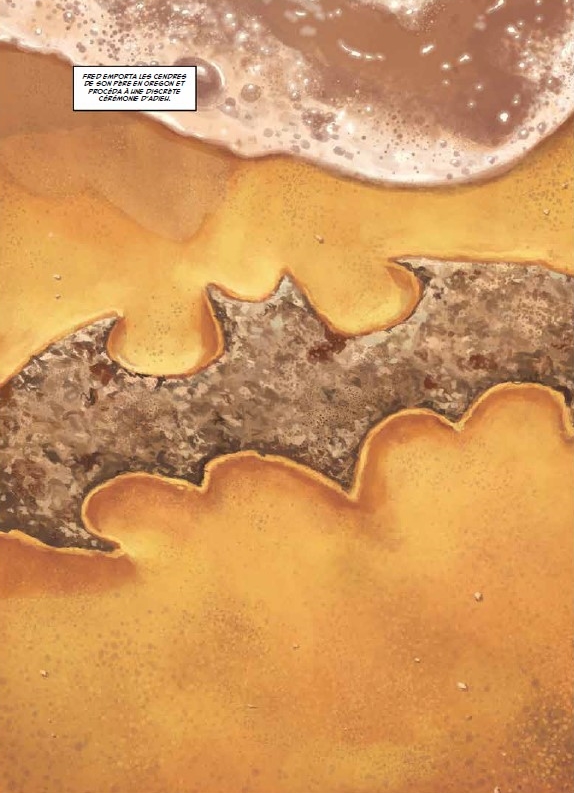
Bonnie said that Fred went to the beach in Manzanita, an Oregon coastal town within driving distance of Portland, and spread Bill’s ashes at the shoreline in the shape of a bat.

Poignant, visually striking—and relieving. The thought of Bill Finger ending up in a potter’s field after his hard life was heartbreaking.  

Since then, at least two others have independently verified the ashes story—or at least their memory of it. But since it’s so specific, I believe it has only two possible explanations: either Fred (or someone else) made it up after Bill’s death and the false story spread, or it is true. I see no incentive to make up something like that, especially because Bill was hardly known to the public, so I have considered the story to be true from the moment I heard it.

It took me years to be able to describe the scene to audiences without choking up a bit.

It was first depicted five years later, in Bill the Boy Wonder: The Secret Co-Creator of Batman, courtesy of Ty Templeton:


It next appeared, animated, in the documentary Batman & Bill:


Then it was interpreted for a Brazilian graphic biography, Bill Finger—A verdadeira história do Cavaleiro das Trevas:


It was most recently seen in Bill Finger, dans l'ombre du mythe, a French-language graphic memoir illustrated by Erez Zadok:


This was such a fabled image in my mind from the moment I learned of it, and it’s been a moving experience to see each new interpretation. It’s also been surreal because for years, the scene existed only in memory and imagination. 

Sunday, July 3, 2022

Students spotlighting little-known true stories

On 2/4/22—rescheduled from spring 2020—I finally spoke at Robious Elementary in Midlothian, VA.


My visit was the kickoff for a student project that is up, down, and all around my alley. 


As my kind host, librarian Melissa West, explained (lightly edited):

we are using [your visit] as a jumping off point for our 4th graders who will embark on a research project looking for an untold story [all tied to Virginia except *]. The project is built on the idea that certain individuals have been recognized, honored, and studied in school for the work that they did, while others who did much the same went unnoticed. Their project that will be part of a museum exhibit at the Virginia Museum of History and Culture.

Funding was provided by Partners in the Arts.

Slides from the presentation about the project:


Here is a partial list, in no order, of people whose stories these kids brought to light (I added the links; they were not necessarily sources the kids used):

three enslaved teens in the household of Thomas Jefferson: Ursula, Edith, and Frances
Acoustic Kitty (CIA operation)
members of the Richmond 34 (1960 sit-in): Woodrow Benjamin Grant Jr., Elizabeth Johnson

Thank you again to Melissa and Robious for promoting the value of research and the thrill of untold stories.


signing the author wall

Saturday, July 2, 2022

Delivering a speech at a high school graduation

On 5/20/20, in Germany, I had the privilege of giving a speech at my daughter’s high school graduation. (It was the IB class, so the ceremony—like their classes—was in English.) 

photos: Oliver Maier

Prior to this, I had not heard of a high school inviting the parent of a graduating senior to speak at this rite of passage, but at my daughter’s school, it is an annual tradition. 

That doesn’t mean the students are excited about it. At that age, kids typically don’t love listening to their parents about even the simplest things. Therefore, my opening line was “Graduates of New York University this week got international Grammy-winning superstar Taylor Swift to speak at their graduation…and you get some random dad.”


I did what I do naturally: tell a story. It is, simply, the best way to immediately grab and retain an audience—kilometers more effective that platitudes. At first the true story I shared might have seemed like a terrible judgment call for the occasion—it’s a tragedy about a wildfire. But at the end, the point becomes clear. That segued into two other topics that at first seem disparate—a dancing man at a music festival and a book by a legendary Hollywood screenwriter—but I tied the three segments together in a way that made sense to me. 


Apparently, I misjudged my audience. I heard that they did enjoy it:


The experience tied together some of my greatest loves—my daughter, speaking to a live audience, and the chance to try to inspire young people. Thank you again, Louisenlund, for the opportunity.

Friday, July 1, 2022

A graphic memoir starring Bill Finger, me…and me

Ten (!) years ago today, Bill the Boy Wonder: The Secret Co-Creator of Batman came out. Hard as it still may be to believe, it was the first book about Bill Finger—38 years after he died. 

If you’d told me then that this unassuming picture (!) book would be followed by a historic credit change, an unprecedented Hulu documentary, a New York City street renaming, and more than one style of Bill Finger T-shirt, I’d have asked if I could feel your forehead. 

Plus, to date, three more books on Bill have appeared.

The first was in Spanish, the second in Portuguese, and the new one in French. (Then there’s the Polish edition of my book.) I speak none of these languages, though I took French in school for five years. (In my defense, those five years weren’t last week.)

This latest Bill Finger book is the second illustrated biography. Yes, we’ve gotten to the point where there is more than one of certain formats.


Bill Finger, dans l’ombre du mythe was written by Julian Voloj and illustrated by Erez Zadok. Less than a month after DC Comics announced that they would add Bill’s name to the Batman credit line, in 2015, I first heard from Julian. He said he was planning a book about Bill and asked to talk with me. Julian has also written a graphic memoir about the creation of Superman, focusing on Joe Shuster.

Though Julian is not French, the first publisher to make an offer on his manuscript was. He is hoping to also put out an edition in English.

Julian was kind enough to involve me in the editing process of the book, and I greatly appreciated that because I am not only protective of Bill’s legacy but also a central figure in his telling. He sent his first draft and Erez’s initial sketches for my review in 2019. 

It was and still is surreal to see my 2006-07 research experiences recreated so vividly. I imagine people who are depicted by someone else (in words, art, or both) often feel it’s a mix of humbling and strange. Those research moments were so private, so localized, so inward. No one (besides me) was documenting me then. I didn’t even have a book contract yet. I had no idea if any of that work would amount to anything. 

confirming the apartment where a 
1940s photo of Bills desk was taken

how I inherited Bills scarab paperweight


discovering Bill’s birth name
(example of creative license; 
at no point in the research did I do a cartwheel)

finding a previously unpublished
Bill photo that is now my favorite
(again an instance of creative license; 
we did not rendezvous on a street corner)

Both Julian and Erez were highly receptive to my feedback (which, true to form, was detailed). An example: Julian uses a storytelling device in which the adult me interacts with the kid me (specifically me dressed in a Robin-inspired costume).


Side note: whether intentional or not, this is reminiscent of Robin’s original purpose in Batman comics—to give a loner main character someone to talk to, and therefore help convey information to the reader without having to use monologue or voiceover.

The original drawings of my Robin costume had a “N” (for Nobleman) instead of Robin’s “R.” I understood that Julian and Erez were taking creative license, and I accepted it in other instances, but in this case I asked if they would either stick with “R” or do away with a letter altogether. Life as we know it would hardly screech to a halt if this little fabrication remained intact, but it felt a bit too self-aware for my taste, and the dynamic duo graciously obliged.


The book is 136 pages with a trim size roughly that of a standard magazine. It is gorgeous and heartfelt. I’m honored that I had a small role in it.

Here is the introduction I wrote for the book:


Oh, you’re partial to English? Thy shall be done:

His Identity Remains Known

Truly by chance, I began to write this on September 18, 2021—which is, as I’m sure you immediately realized, the sixth anniversary of the announcement that DC Entertainment would add Bill Finger’s name to the Batman “created by” line…76 years late.

I don’t need an anniversary to celebrate Bill Finger. I’ve been doing it almost daily since I began researching him in 2006, though those early months were mostly a party of one. 

Bill was, creatively, the primary influence behind a character who became one of the most iconic fictional heroes of all time. Ask a person who has never read a Batman story or seen a Batman show/film to name three things related to the Dark Knight. First, she will be able to do that. Second, unless she says “Harley Quinn,” all three will almost certainly be Bill contributions. 

I set out to write a book, but I knew from the start that I was also setting out to try to fix a mistake. It’s still mystifying to me that no one had already published a biography of Bill, and I remain grateful that, somehow, I got to be the first. 

That’s not to say that no one knew of Bill. Thanks to fandom chatter at comic conventions and later message boards and social media, word spread that artist Bob Kane was not alone at bat. Some lamented Bill’s fate and called for justice. But because Bill wrongly appeared as only a cameo in most published sources covering the Batman creation story, many fans knew little about the degree of his involvement…and almost nothing about the man himself. 

That began to change in 1965, on the eve of the debut of the now-mythic TV show that elevated Batman from comic book hero to pop culture icon.

Batmanians (a pre-existing word, yo) owe a cave-sized debt to a man named Jerry Bails. 

Jerry was many things to comics history, notably the first known person to interview Bill Finger. Based on what Jerry learned from that interview, he wrote a two-page article. It was not published in Time or Newsweek, though some form of it could’ve and should’ve been. Instead, Jerry mimeographed it (blue paper, smudgy purple ink) and mailed those copies to other Batman fans—Batmanians—nationwide. Simple as this seems, it was a radical move. Jerry was a fan first. But not at the expense of the truth. And this truth was titanic. It would debunk (and therefore irk) one of the most famous names in the business.

I had the privilege of corresponding with Jerry about Bill. I received his first email on May 31, 2006, and last on August 14. I’d reached him just in time; only three months later, Jerry died. He might’ve thought that I was just another annoying wannabe crusader who would never follow through on a book. I wish he knew that he passed the Bill baton to someone who was willing to stick to the mission. Perhaps I should say Bat-on… (It’s okay. Bill used puns.)

Other Bill champions who predated me and whom I acknowledge whenever possible include superfan Tom Fagan, Bill’s longtime writing partner Charles Sinclair, comics legend Jim Steranko, comics writer Mike W. Barr, Bob Kane biographer Tom Andrae, Bill’s second wife Lyn Simmons, and early Batman ghost artist/creator advocate Jerry Robinson. In various ways, each of them did something meaningful on behalf of Bill’s legacy, sometimes after his untimely death at age 59. Unfortunately, like Bails, Fagan and Robinson also died too soon (2008 and 2011, respectively) to see Bill get his long overdue validation.

In my efforts to commemorate Bill, I failed…a lot:

  • Bill the Boy Wonder was rejected 34 times (including three times by the editor of my previous superhero-related biography, Boys of Steel: The Creators of Superman). 
  • Batman & Bill was the third attempt to make a documentary about Bill Finger; the first two attempts imploded, in 2009 and 2011 (though footage from each is in the final film). 
  • I proposed the installation of a statue or memorial for Bill in New York City (where Batman was born). I was dismissively told that Bill is not a suitable subject. 
  • I proposed a Google Doodle for what would have been Bill’s 100th birthday (as well as Batman’s 75th anniversary and the 40th anniversary of Bill’s death). Even though the public flooded Google with support for the idea—I think the biggest push for a Doodle up till that point—it wasn’t enough.

Even in death, Bill couldn’t catch a break.

Why go through all of this for a person who had been dead for two generations? Especially a person who, by virtue of being a white man, had privilege, not to mention steady writing work for 25 years and, some argue, obligation to speak up more forcefully for himself? 

Because no matter what, you should get credit for what you do (good and bad). Credit is a key component of our dignity. Lack of credit for one of us is an existential threat to all of us. This fight was for Bill, of course, but also for every creative whose intellectual property has been stolen. Taking a person’s idea is saying “You have something of value but you yourself are not valuable enough to be acknowledged.” 

Family, friends, and fans tried for decades to get recognition for Bill. Some, like me, were told flat-out: I’m all for it but don’t waste your time. It will never happen.

It took far too long, but it did happen. If Bill’s legacy was preserved despite the odds, anyone’s can be—with persistence. No story starts with “Let me tell you about the time I gave up…”

A credit is like a gravestone—a forever marker to honor a person. Both are surrounded by beauty (gravestone by nature, credit by art). Bill Finger has no gravestone, but now, finally, he has credit. Official credit. On every Batman story. Way better than a statue.

The last line of the first panel of the first Batman (then “Bat-Man”) story is “His identity remains unknown.” Bill wrote it referring, of course, to Bruce Wayne’s secret identity—but eerily, unknowingly, it would also come to describe Bill himself. Yet like the hyphen in the hero’s name, Bill’s anonymous status is now a thing of the past. Now his identity remains known, permanently. I only hope that he knows it.

Fred Finger on an Oregon beach, 

3/27/24 addendum: now available in German.